


[ad_1]
Sure! Here’s a rewrite of your content while preserving the HTML tags:
Secure your preorder of Linkin Park’sFROM ZERO deluxe edition at the AP Shop.
In September 2024, Mike Shinoda graced the stage at Warner Brothers Studios to announce the much-anticipated return of Linkin Park. The atmosphere was electric, and fans online were eagerly streaming the announcement worldwide.
Linkin Park’s captivating blend of heavy rock and hip-hop, coupled with their raw and impactful lyrics, has kept fans engaged for years. The band bravely addressed tough topics like depression and abuse with heartfelt honesty, embodying a powerful emotional range in both their sound and lyrics. From their inception, they forged a connection with listeners that resonated deeply. One comment on a shaky YouTube clip of their announcement captures it well: “This is what LP created for us.”
Read more:How Linkin Park’s “In The End” became a global sensation
The essence of Linkin Park, irrespective of changes in time, lineup, or sound, has consistently been their loyal fanbase, according to Shinoda. As they embark on this new journey following FROM ZERO and integrate fresh faces into the project, it’s clear they are committed to maintaining that heartbeat. Moreover, they are eager to establish a new narrative—sharing stories that reflect both current experiences and future aspirations. “We discussed how we want the set to feel more natural,” Shinoda notes. “It’s about focusing on the connection with the audience rather than the technicalities of performance. I feel like we’ve reached that point.”

In a conversation with AP, Shinoda, bassist Dave Farrell, and new lead vocalist Emily Armstrong explored the concept of legacy—what it means to be part of one and to build one together—while also looking forward. They discussed the core of Linkin Park—a band that embodies community, connection, and a passion for genuine expression. “It’s truly about the shared experience,” Shinoda says with enthusiasm. “Once a song is recorded and hears the audience’s attachment—experiencing that together is what it’s all about. It transcends the song itself.”
Shinoda’s sentiments are not mere clichés. Exiting Barclays Center in Brooklyn after Linkin Park’s second show since their return, I witnessed an extraordinary sight—throngs of fans flowing into the streets of New York City, united in song. Shedding their reservations, concertgoers removed their earbuds and belted out: “In the end, it doesn’t even matter.”
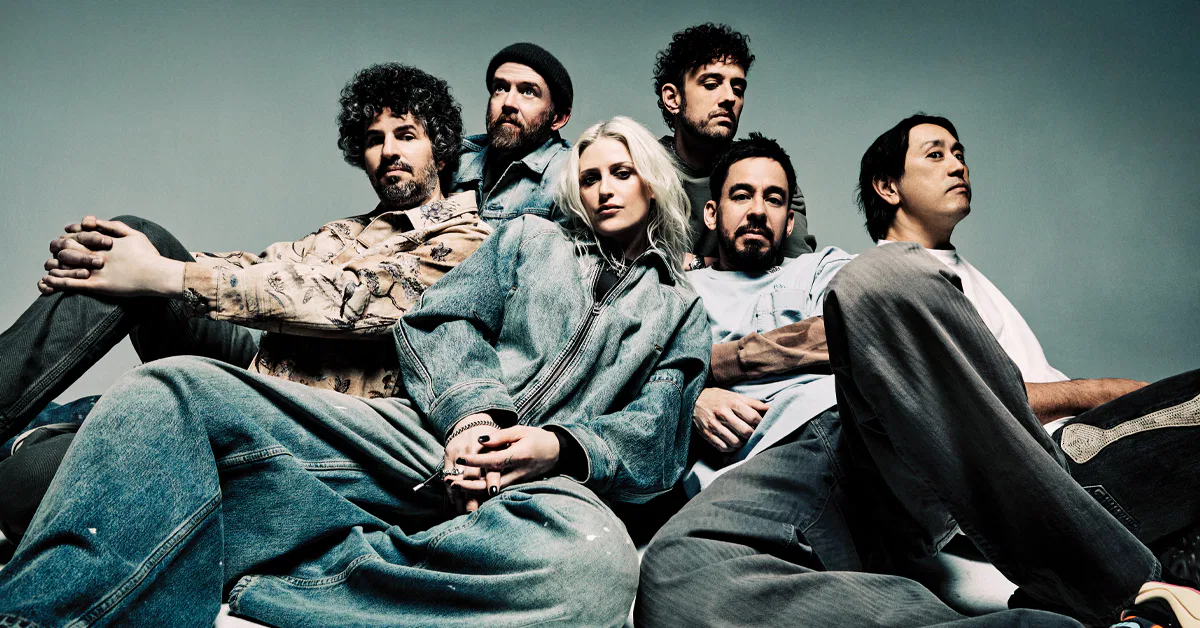
That evening in September, Farrell and Joe Hahn, long-standing members who joined the band (initially named “Xero”) during its early days, stood alongside Shinoda. However, this iteration of Linkin Park was a fresh chapter for longtime fans. The band not only announced a new album and world tour but also introduced Colin Brittain as their new drummer and Armstrong of Dead Sara as the lead vocalist. Armstrong’s inclusion sparked excitement online even before the official announcement, stirring diverse reactions across the alt-rock community.
Familiar, yet renewed, Armstrong’s vocal delivery combines her fierce scream with a soulful, gritty belt. The chemistry between her and Shinoda is electric, creating a dynamic interplay that captivates audiences. The end result is a series of expansive anthems that feel both textured and accessible. Their live performance radiates focused energy as the chemistry among new members solidifies with each show. Brittain seamlessly integrates with Farrell’s iconic bass lines, framed by pulsating synths. Armstrong, an inherently strong performer, continues to grow within the band, showcasing more of her personality on stage with each performance. Engaging with the affable singer reveals her commitment to navigating her place in the group—honoring the legacy while assertively carving out her space.
In their private moments, the band members share laughter and playful teasing, akin to siblings—engaging in silly antics and friendly Rubik’s Cube contests when the cameras are off. Observing their camaraderie is refreshing; it reveals that their bond extends beyond the stage, a feat challenging for bands with their level of success, particularly one that rarely takes breaks. “Everything is new for me,” shares Armstrong. “You can’t rush the process. You have to go through it. We’ve reached a point where we can now introduce new songs without feeling overwhelmed by inconsistency. That’s a great achievement for us.”
Since their announcement, it’s been a whirlwind of activity, with both veteran and new members thriving at the center of it all, eager to share their collective experiences with their audience. Thus, just months after releasing their album and on the verge of embarking on another massive tour, they are offering even more. The deluxe edition of FROM ZERO will feature three new tracks, each weaving elements of Linkin Park’s enduring legacy into their current narrative. From the energetic “Up From the Bottom” to the rap-rock standout “Unshatter” and the introspective “Let You Fade,” which delves into themes of personal growth, the deluxe album provides a broader perspective for understanding the new chapter of Linkin Park — illuminating where they’ve been and where they intend to go.
Artists often have varied emotions regarding the post-album release phase. Sometimes, once an album is out and they’ve toured with it, they lose interest and don’t want to revisit it. How do you feel nearly six months afterFROM ZERO was released?
EMILY ARMSTRONG: We haven’t performed all the songs live yet, so I’m definitely not over it. We’re preparing for rehearsals here in LA and will soon play the new songs. I can’t wait to see if I appreciate the songs even more than I do now or if my feelings might change. We’ll find out.
MIKE SHINODA: At the end of the year, when I checked my Spotify Wrapped, some of our songs were among the most played. I was a bit frustrated to see that part of my list was taken up by our songs. My top track was “New Divide.”
DAVE FARRELL: That’s probably because I contributed to the bassline and Mike was playing a bassline on the keyboard—we keep messing it up!
SHINODA: We’re supposed to synchronize our notes, but with all the nuances and changes in the song, our playing sometimes overlaps incorrectly. To our ears, the mistakes are pretty apparent.
FARRELL: It became a running joke. I’m not sure if we’re close to mastering it!
SHINODA: It’s funny that it became such a big deal that it ended up being my No. 1 song of the year.
ARMSTRONG: We’re all professionals here!
Let’s discuss the new songs featured on the deluxe album. Were they created during the tour?
SHINODA: Well, “Up From the Bottom” was completely new, crafted between show dates. “Unshatter” originated entirely during our FROM ZERO sessions, while “Let You Fade” was partially created during those sessions too. We completely reworked the structure and music in December, between performances.
FARRELL: Some songs just take longer to reach a sense of completion. For me, “Let You Fade” was one of those songs where I felt an initial spark. The first time I played it, I knew there was something special, but it took various iterations before it was ready to share. Others came together much more quickly.
I imagine that actively touring, having the new album out, and experiencing life as it unfolds — all of that alters your relationship with the music and the creative process.
SHINODA: That’s absolutely true. Typically, we’re a band that spends elongated periods on one aspect—either in the studio or on tour—but occasionally, the two blend. With upcoming tour dates, we felt the urge to release additional songs to offer something fresh for fans to engage with, listen to, and enjoy.
What does your collaborative process look like with this new version of Linkin Park? How does it manifest in the studio and live?
SHINODA: It’s complex and often changes. There’s no singular method—as a band, we’ve explored various songwriting approaches. Fans tease me for referring to the “tools in the toolbox.” We have numerous ways to create, and what excites me is continuing to experiment and utilize different methods. Having newcomers like Colin [Brittain] and Emily injects a sense of novelty, as they each bring their unique perspectives and ways of working that are new to me.
ARMSTRONG: I arrive and assess where the song stands, deciding whether or not to contribute. Initially, everything seemed to be working for them, so I questioned how I could help elevate it. Therefore, observing their dynamics was informative. I felt like this team already had a strong foundation, and I aimed to learn from it.
SHINODA: You can picture her as the ideal house guest. [Laughs]
ARMSTRONG: It’s exhilarating to be part of it! And yes, I absolutely contributed to the process.
SHINODA: What I appreciate—something I’ve mentioned before—is when Emily can turn off her mental filter and spontaneous ideas just flow. This quality is remarkable in her, leading to a wealth of unexpected but special lyrical and vocal moments on the record. For example, on “Casualty,” there’s a spontaneous phrase—“Let’s get out alive!”
ARMSTRONG: That was a quirky moment.
SHINODA: She blurted it out during the song, and I thought, “What was that?” I would never have written that myself. Those words felt disconnected from the song but we decided to keep it! Times like those add a refreshing uniqueness to our music.
Speaking of uniqueness, Emily, does that spontaneity characterize your work process with Dead Sara?
ARMSTRONG: Absolutely, it’s very stream-of-consciousness. Take our hit, “Weatherman”—it emerged with ease, no deep thought behind it. Initially skeptical about the title, I was outvoted because everyone thought it sounded compelling. So, I went with it.
Finding that sweet spot, being able to shift your creative approach—especially when it’s not your usual style—is quite impressive.
SHINODA: Having studied visual art, I view the dichotomy between fine art and illustration, where illustration demands a more structured approach, while fine art allows for wild creativity. In our music, we can embrace both organized thoughts and free-flowing creativity.
ARMSTRONG: Meanwhile, I didn’t even finish high school.
SHINODA: So perhaps no brain! [Laughs] But that’s exactly the kind of balance I’m looking for. I genuinely believe that’s what we stumbled upon 15 years ago. When collaborating with Rick Rubin, we aimed to enhance our intuitive side. People often tease some of his work with the Chili Peppers for having abstract, nonsensical lyrics, but when you hear them, you think, “That’s interesting, who else would do that?”
ARMSTRONG: Those moments definitely stick. Once something is laid down, it’s hard to transform it—there’s a uniqueness that can’t be replicated.
SHINODA: It happens live as well; not just in lyrics, but even in vocal performances where something extraordinary occurs—those moments often become the most memorable.
FARRELL: There exists a balance between overthinking and underthinking, where creativity flows naturally. Everyone has their tendencies. Striving for that balance can be elusive, but it’s the goal we chase.
I’ve heard it said that “‘I don’t know’ is one of the most powerful phrases.” Given the distinct creative journey you’re on, that sentiment resonates. I’ve also tuned into the episodes of Rubin’sBroken Record podcast where he analyzes the Chili Peppers’ records with the band, discussing his unique production approach.
SHINODA: I really enjoyed his conversations with John Frusciante. John embodies that modest space, while Rick’s strength lies in stepping back. One valuable lesson we’ve all learned is to remain attuned to where a song wants to evolve. It’s almost as if we’re channeling something universal through the music. When I can tap into that feeling, I sense when a song becomes special, but it’s challenging to articulate.
Does that exhilarating feeling ever happen during live shows—do you experience those moments in real-time?
FARRELL: It exists in a different form, though it certainly shares similarities. For me, the magic of live performances lies in the connection with the audience. I think what Mike referred to is akin to the emotions you feel when experiencing something profound, almost like goosebumps—it’s elusive. In the studio, we chase those moments where an idea clicks, prompting a feeling of discovery and wonder. We want to cultivate those special moments instead of feeling burdened by laboriousness. To me, the live experience is one of music’s greatest gifts—unique to the presence of an audience. Without others, you miss out on the essence of a live performance.
Mike, you mentioned this chapter as part of your “ongoing journey.” I’d like to ask, what do you believe has been the core of Linkin Park throughout? What distinguishes this chapter aside from the obvious new members?
SHINODA: For me, it’s the community—the culture surrounding the band is larger than the band itself. It endures even when the band isn’t present. Consider the people on the subway—that connection is independent of us. They create a shared experience supported by our music, which has been a constant thread since the beginning. We began by sending out stickers and demos to spread the word, and soon fans were connecting over it. When we finally performed in their areas, that synergy blossomed. What’s exciting now is that while the band’s identity has evolved, the fundamental connection remains; live audiences have also matured alongside us.
If you weren’t musicians, what do you imagine you would be doing instead?
FARRELL: I’d likely be a professional basketball player. LeBron would be playing elsewhere, and I’d also tower over him.
SHINODA: Only a foot taller?
FARRELL: If I played as a guard, I’d be 7’4” instead of 6’4”.
SHINODA: Wait, you’re not even 6’4”! [Laughs]
FARRELL: I was pre-med in school but quickly realized I dislike the sight of blood. So music became my path, and I never diverted.
ARMSTRONG: I’d probably pursue a career in professional dance due to my onstage charisma. [Laughs] In reality, I’ve always loved sports, so I envision that could have been a likely route. In high school, a coach even considered connecting me with universities.
SHINODA: Was basketball your first passion?
ARMSTRONG: Yes, basketball came first, followed by a love for skateboarding. Ultimately, in high school, I had to choose, and performing with Dead Sara led me to realize my true calling.
SHINODA: It’s admirable to discover your passion early. Many people struggle to find their path.
ARMSTRONG: Absolutely, I recognize how fortunate I am.
SHINODA: My artistic journey was rooted in drawing and painting. I had always perceived that as my path, but as our weekend gigs at The Roxy gained traction, I began to question if that was truly my direction. My mom urged me not to leave college and to finish my degree, so I extended my enrollment for three more months once we signed a record deal.
How do you manage to stay grounded? Your schedules seem relentless—always on the move, in the studio…
SHINODA: We keep each other in check by making light-hearted jokes whenever anyone gets a bit too carried away.
So, you shame each other?
SHINODA: Exactly. We believe in playful shaming! That’s our formula for grounding each other.
FARRELL: Bringing back shaming as a tool!
SHINODA: We need more shaming in the world—there’s a quotable line! At least we’re bad at it together.
Let’s discuss your supporting acts. What does that selection process entail?
SHINODA: We compile a wishlist, and everyone in the band contributes names. We evaluate who fits the size of our venues. For example, we had Sleep Token support a show last year, which was ambitious since they’ve recently gained immense popularity. Personally, I campaigned for Jean Dawson due to my admiration for his music. He’s an ideal opener, but depending on other acts on the lineup, we sometimes need to pair him with someone larger. We have more collaborations coming with Jean, along with Architects, PVRIS, grandson, Spiritbox, and JPEGMAFIA. We’re particularly thrilled about collaborating with ONE OK ROCK.
While exciting, it must also be stressful to select complementary acts. Considering all this, what would the title of this chapter be? What would be its thesis statement?
FARRELL: I resonate with the notion that you either win or learn, but never lose until you give up. That principle applies across all aspects of life, from simple family matters to larger projects. After a period of recalibration, we collectively focused on what our future may hold and how we envision this new chapter. Navigating through that process—regardless of the outcomes—is crucial for me.
I wasn’t willing to neglect identifying our next steps, both as Linkin Park and as close friends. This endeavor consumes a significant portion of our lives, identities, and collective efforts. What does the trajectory look like moving forward? Exploring our friendships as well as integrating Emily and Colin added vibrancy to this journey—it’s genuinely special.
ARMSTRONG: Initially, contemplating the legacy felt overwhelmingly daunting. Yet, immersing myself in the current moments and the momentum present in the room was vital. The energy shared with everyone was palpable, and I wanted to deliver something meaningful for the fans. I felt strongly that we had something to prove—deep down, I sensed that this journey was far from over, even as I entered a dynamic ecosystem.
SHINODA: Indeed, everyone who joined us in the studio had little knowledge of one another. One exception was when Teddy Swims recorded on a track, and Emily inquired about him, intrigued by his talent. Collaborating with Emily and Colin felt right; we embraced fresh creative combinations and thrived together.
Even if the fan response had been overwhelmingly negative and we faced a public backlash, we would have derived fulfillment from the joy we experienced while creating. We knew we had fun and produced something special, irrespective of external validation.
ARMSTRONG: Considering the various potential paths we could have taken, we felt it all could have unfolded in numerous ways.
It seems things have worked out well.
ARMSTRONG: I believe so.
SHINODA: So far, so good.
Feel free to ask for any modifications or further adjustments!
[ad_2]
Source link