



[ad_1]
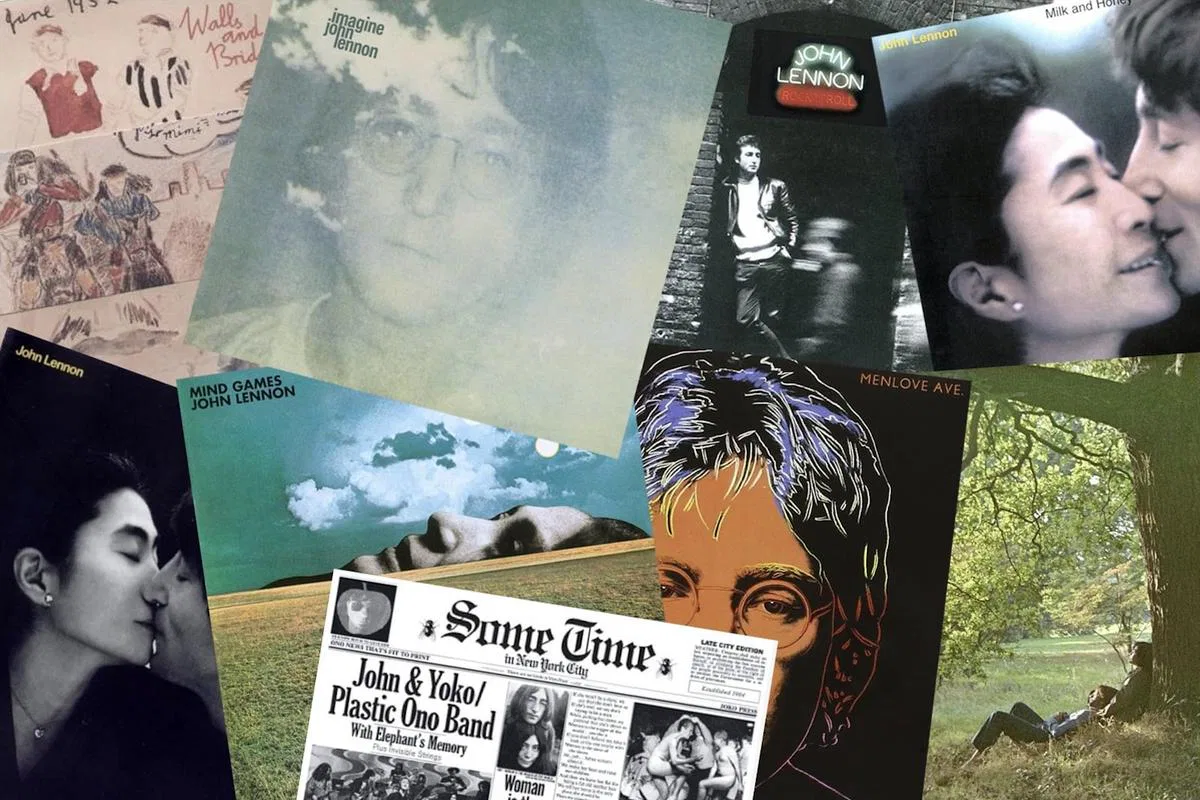
Following the Beatles’ breakup, John Lennon released only seven solo albums over the span of a decade. The posthumous albums Milk and Honey and Menlove Ave. brought the total to nine. Given the limited number of albums, each choice for the opening track carries considerable weight.
As always, Lennon’s selections were often contentious, evocative, and imbued with a unique joy—or a mix of all three.
He faced stark realities on 1970’s Plastic Ono Band and 1974’s Walls and Bridges, while reflecting fondly in 1975 on Rock ‘n’ Roll and in 1984 on Milk and Honey. The 1972 album Some Time in New York City certainly stirred up its share of controversy.
READ MORE: 20 Beatles Songs That John Lennon Hated
At times, Lennon showcased some of his finest work right from the start, as heard on 1971’s Imagine, 1973’s Mind Games, and 1980’s Double Fantasy. These albums each featured a U.K. No. 1 single, an international Top 30 hit, and a Billboard chart-topping success.
Here’s a ranked overview of every opening track from John Lennon’s tragically brief solo endeavor:
No. 9. “Woman Is the N—– of the World”
From: Some Time in New York City (1972)
In shedding his youthful bravado, Lennon returned to a phrase Yoko Ono shared shortly after they met in 1968, which became the provocative title of this song. Unsurprisingly, radio stations refused to air it, leading to the single’s unfortunate halt at No. 57 on the Billboard Hot 100, marking it as the lowest-charting U.S. single during Lennon’s life. “Borrowed Time” managed a peak at No. 108 nearly four years following Lennon’s death.
No. 8. “Be-Bop-a-Lula”
From: Rock ‘n’ Roll (1975)
This long-awaited collection of early rock covers kicked off with a song significant in Beatles history. Gene Vincent’s 1956 debut single “Be-Bop-a-Lula” not only became a Top 20 hit but also won young Lennon over. The Quarrymen, Lennon’s teenage band, performed this song at a church garden party in Liverpool in July 1957, where Lennon first met Paul McCartney. “The day I met Paul, I was singing that song for the first time on stage,” Lennon later recounted to Rolling Stone.
No. 7. “I’m Stepping Out”
From: Milk and Honey (1984)
This uplifting track was among the first attempted during the sessions for Double Fantasy, Lennon’s comeback album after focusing on raising his son, Sean. Unfortunately, the song was left unfinished, and the early version included on the posthumous Milk and Honey is merely a rough draft. “I’m Stepping Out” was eventually the third single from this album but fell short, charting 50 spots lower than the No. 5 hit opening track, “Nobody Told Me.”
No. 6. “Here We Go Again”
From: Menlove Ave. (1986)
Little emerged from Lennon’s deteriorated final sessions with a disturbed and paranoid Phil Spector, though they co-wrote this leftover track. However, it’s unclear what Spector contributed, and an original composition didn’t align with the oldies project Lennon was pursuing. In the end, only three Spector-produced tracks made it onto Rock ‘n’ Roll, with “Here We Go Again” surfacing posthumously.
No. 5. “Going Down on Love”
From: Walls and Bridges (1974)
Similar to “Surprise, Surprise” from Walls and Bridges, “Going Down on Love” began with a significantly different vibe. Early iterations aligned more with the raw honesty of 1970’s Plastic Ono Band. As Lennon layered in new elements, particularly a punchy horn section, what began as a desolate commentary on his tumultuous love life transitioned—at least sonically. A glance at the lyric sheet underscores the fact that a conflicted Lennon was teetering on the edge of an emotional chasm.
No. 4. “Mind Games”
From: Mind Games (1973)
What if “I Am the Walrus” wove in an anti-war message? That’s the essence of the title track from Mind Games, as Lennon sprinkles whimsical Lewis Carroll-inspired references throughout, all while criticizing the Vietnam War. “Mind Games” evolved from a straightforward demo titled “Make Love Not War,” aiming for a protest theme akin to “Give Peace a Chance.” Lennon’s persistent refinement led to a delicate balance of fantastical notions and social commentary, likely aiding this single in capturing a spot in the U.S. Top 20.
No. 3. “Imagine”
From: Imagine (1971)
Lennon articulated it well: This U.K. No. 1 hit was “anti-religious, anti-nationalistic, anti-conventional, anti-capitalistic—but because it is sugarcoated, it is accepted.” Yoko Ono played a key role in completing “Imagine” and later received a co-writing credit. Recognizing the irony of a rock star urging others to let go of material possessions, Lennon subsequently altered the lyric in a performance heard on Live in New York City from “I wonder if you can” to “I wonder if we can.”
No. 2. “Mother”
From: Plastic Ono Band (1970)
Lennon transitioned from guitar to piano as he crafted this emotional outcry for his absent parents. “I express myself best in rock, and I had a few ideas to do this with ‘Mother’ and that with ‘Mother,’ but the piano does it all for you,” Lennon shared with Rolling Stone. “Your mind can do the rest of it.” Former bandmate Ringo Starr provided a minimalist rhythm that amplified the raw emotion within the lyrics. Lennon recorded the devastating final moments in single-line takes to preserve his voice, showcasing a pain that is utterly excruciating.
No. 1. “(Just Like) Starting Over”
From: Double Fantasy (1980)
Lennon fused three demo concepts to create what would become his last single during his lifetime: “My Life,” “Don’t Be Crazy,” and “The Worst Is Over.” “(Just Like) Starting Over” transformed into an international No. 1 hit shortly after Lennon’s death. It marked a return to an open-hearted sound reminiscent of his early days with the Beatles, both musically (with nods to his youthful influences) and lyrically (as he looks forward with unreserved optimism). This feeling of renewal, within its context, can be perceived as a bittersweet letdown. Resist that urge; this is pure joy, unadulterated joy.
Beatles Solo Albums Ranked
Included are albums that still echo with the passage of time and others that have risen in esteem.
Gallery Credit: Nick DeRiso
How an Old Beatles Song Connected David Bowie With John Lennon
[ad_2]
Source link