



[ad_1]
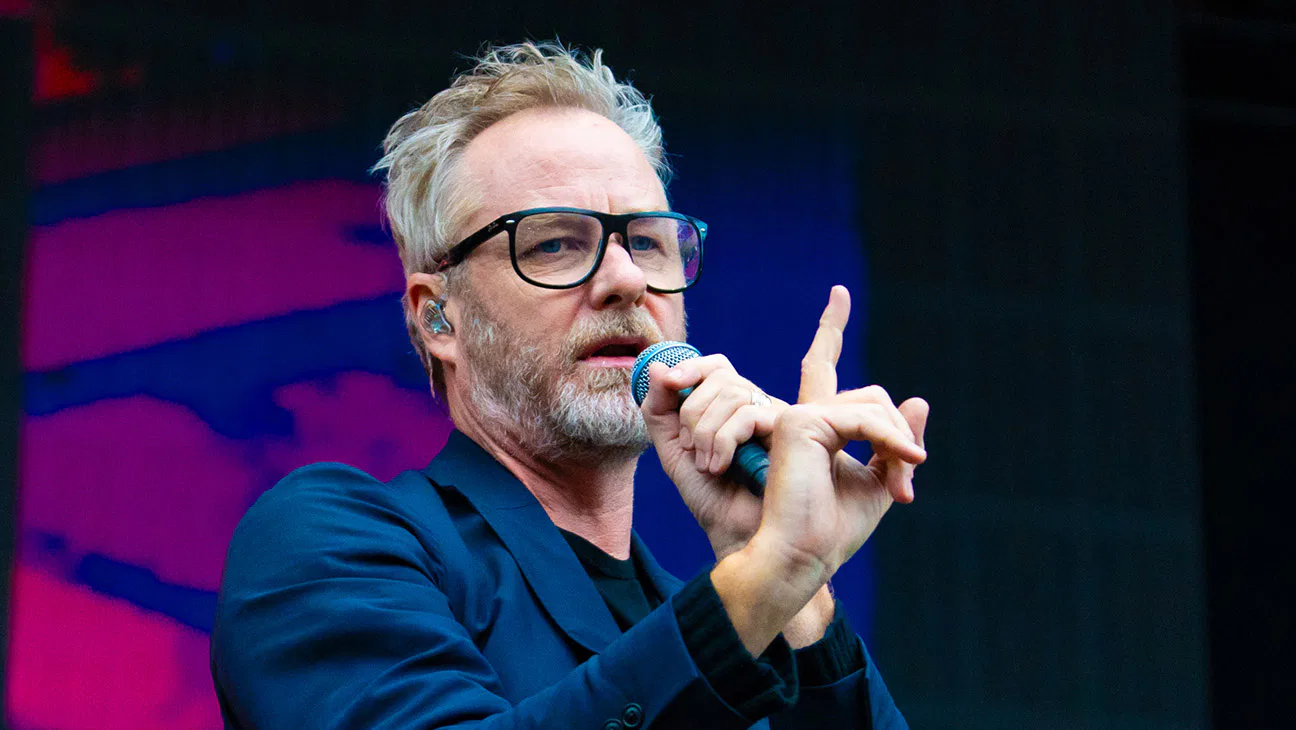
At first glance, it might seem like Matt Berninger has little to be sorrowful about. The celebrated leader of The National, 54, has a friendly rapport with Barack Obama, holds meetings at the San Vicente Bungalows (a trendy members’ club mentioned on his latest solo album, Get Sunk), and enjoys a friendship and collaboration with Taylor Swift; he lent his voice to “Coney Island” from Evermore in 2020, and she reciprocated with an appearance on The National’s 2023 track “The Alcott.”
Despite this, the somber title Get Sunk and several tracks on the album originated during a period of deep depression that left Berninger concerned he might never perform again. Recently, however, the scruffy poet laureate of middle-aged sadness has found a new sense of joy and creativity, emerging from a post-pandemic surge that has included the release of multiple albums with The National, along with his second solo project following 2020’s Serpentine Prison.
Berninger joined The Hollywood Reporter via Zoom to discuss overcoming burnout, his “pile of Legos” lyrics, and the unique connection between sad fathers and teenage girls.
Hi, Matt. Where are you right now?
I’m in my barn in Connecticut.
You lived in L.A. before this, right?
Yes, I’ve been here nearly two years now. Before that, I spent a decade in Venice, California, and 15 years in Brooklyn, following a century in Cincinnati, Ohio.
Which of these places has had the biggest impact on your worldview?
Cincinnati shaped me, but Brooklyn altered that perspective significantly. New York had a profound effect on me, and when I felt I was no longer evolving, I got restless and moved to California. Changing locations does shift how your mind, body, and soul function. I genuinely believe that.
Your songwriting must also evolve with these changes, I imagine.
Absolutely. There’s a deliberate attempt to evolve, but sometimes it feels forced, creating songs that don’t reflect true change. You have to find ways to surprise yourself. I previously wrote in notebooks, switched to my phone, and now I’m trying to abandon both. I’ve taken to writing on whiteboards, baseballs, and books I read—like my copy of Great Gatsby, which houses the lyrics of potentially two albums.
I caught The National’s show at the Hollywood Bowl last fall.
The last three years for The National have been some of the healthiest of our careers. I faced a long depression and writer’s block that I’ve mentioned before. However, creating the last two albums and touring, including our live Rome record and traveling with The War on Drugs, has become the most enjoyable period I’ve experienced with The National.
It shifted my perspective of you. Your performance exuded playfulness, and I appreciated your theatrical and relaxed approach to fronting the band.
I’ve shed my fear of audiences and my fear of looking silly—even to a potentially unhealthy extent. During my depressive phase about four and a half years ago, I was scared of everything: of never writing another song, of never being able to get on stage again, of losing my identity as an artist and graphic designer.
The pandemic contributed to it, but I was juggling too many responsibilities, leading to burnout and a physical and mental collapse. My new album title, Get Sunk, along with four of its songs, were created before I hit rock bottom. However, I emerged from that bad phase and found singing on stage more enjoyable than ever. I’m no longer afraid of simply standing still, which applies to my songwriting and everything else I’m pursuing. [He gestures at a whiteboard behind him filled with writing.]
What do we see there? I notice a grid. Is each box a song or is there a different system?
Yes, it features several songs, and I’m writing the lyrics on that grid. I plan to compose the entire record using those boards.
That’s incredible. It reminds me of a TV writers’ room.
It keeps the process enjoyable. Writing with permanent Sharpies on a whiteboard feels rebellious since it’s meant to be erasable. However, transitioning to whiteboards with Sharpies was liberating. It felt like I was breaking a rule, which encouraged me to break the rules with my words as well.
I realized my major mistake was accepting too many commitments and believing I could juggle multiple projects when, in reality, I can only handle a few. I feel confident about my plans over the next eight years, both with The National and my solo projects.
What does your solo career provide that The National does not?
The National fulfills all my creative desires; I can do anything with the band. I’ve created a documentary with my wife and brother through The National and made a short film with Mike Mills called I Am Easy to Find, which is incredibly special to me. Through The National, I’ve even met President Obama four times.
Is Obama a superfan? Do you make it onto his year-end lists? What do you discuss?
We’ve made it onto his list a couple of times. Once, at a fundraiser at Reese Witherspoon’s home, we were there to take a photo with him. My brother tried to avoid crowding him and circled around, startling Obama, who didn’t realize he was there. However, Obama recognized him and exclaimed, “Oh! It’s Tom! The brother!” He knew Tom as his brother. Barack Obama is incredibly charming, warm, and engaging. The same can be said for Michelle Obama; I received a big bear hug from her.
So, The National has given me everything I’ve ever dreamed of. What do I gain from my external projects? More enjoyable ventures with fun people. I only collaborate with friends—and I have numerous ones.
Your lyrics are undoubtedly a major attraction. Is there any lyric on Get Sunk that you’d like to elaborate on? Perhaps a particularly personal one or one you take pride in?
The song “Nowhere Special” has, I don’t know, 10,000 words. It contains more lyrics than perhaps the rest of the album combined. The lyrics occupy the entire inside sleeve. The thoughts are intricately interwoven. Interestingly, “Don’t make me cry in the back of a black car” wasn’t even originally mine; my friend Jamie wrote that and shared it with me. It’s amusing that the first line that resonated with me wasn’t mine.
I’m currently looking at the lyrics to “Nowhere Special.” The line “So I’m late for the bungalow meeting” strikes me as quite Hollywood. What does it mean to you?
Admittedly, that’s a clumsy lyric, as “bungalow” isn’t the greatest word for a song—it’s on par with “supple” or “custard.” However, it represents a story. I was late for a meeting with my label, Concord, regarding this record Get Sunk because I was running out of budget and time. We had arranged to meet at the San Vicente Bungalows in L.A.
I suspected as much but didn’t want to make assumptions.
Yes, I was indeed late for that meeting—the day after The National performed at the Hollywood Bowl.
No way. I feel so invested now.
I recorded “Nowhere Special” the afternoon following the Hollywood Bowl show. It was the last song we produced for the album, a true Hail Mary moment. I combined all the lyrics I had liked but hadn’t previously used, while dealing with latency issues in my headphones and with the click track. The lyrics regarding the click and latency mirrored my actual experiences. I simply needed lyrics, so I jotted down everything.
The result was a stream-of-consciousness collection, a pile of Legos. I often describe my lyrics as a collage or assembling Legos. At times, I’ll meticulously refine a single green Lego for a month, but other times, it’s just a jumbled collection. I believe “Nowhere Special” marks the first instance where I crafted a song that resembles a pile of Legos. Yet, it’s not random or mere refrigerator-magnet poetry—it has intention.
Your work embodies beautiful chaos.
It’s enjoyable. The more chaotic the experience, the more fun it becomes. Even during live performances, the more chaos and mishaps that occur, the more enjoyable it is for me these days. It’s risky territory, but I’m unfazed. Rock and roll doesn’t kill.
On that tour, you were selling “Sad Dad” T-shirts, if I remember correctly.
Most people perceive a few defining aspects about anything. A long time ago, it seemed The National was primarily associated with sadness and aging. I’m 54, and I was writing about children even before having my daughter. I penned a song titled “Slipping Husband” before meeting my wife.
And you chose to embrace that stereotype with your merchandise?
Exactly. A bit of self-deprecation. If that’s how people perceive us—which isn’t entirely off the mark—let’s own it. We are all fathers grappling with anxiety and depression. Thus, “sad dads” it is. Ironically, it seems to resonate greatly with teenage girls or young women. Phoebe Bridgers mentioned a genuine connection between the male middle-aged mindset and the teenage female mindset, which oddly makes sense to me. I have a teenage daughter, and we understand each other well.
Then, with all the amazing work that Aaron [Dessner, The National’s guitarist] and Taylor Swift have created together, I’m excited to be part of it. I met Taylor seven years ago in L.A., and we became fans of each other. It started with friends suggesting collaborations. Folklore is an absolute masterpiece. The connection between Taylor’s fan base and The National—the introspective, anxiety-ridden, melodramatic themes I enjoy writing about—align perfectly.
There’s a clear link. Teenagers’ search for joy, fun, and pop music contrasts with my darker, introspective themes, creating an intriguing blend. There exists a distinct relationship between the melancholy music of older individuals and teenagers because depressed older individuals are often the ones expressing genuine truths that younger audiences seldom encounter.
[ad_2]
Source link