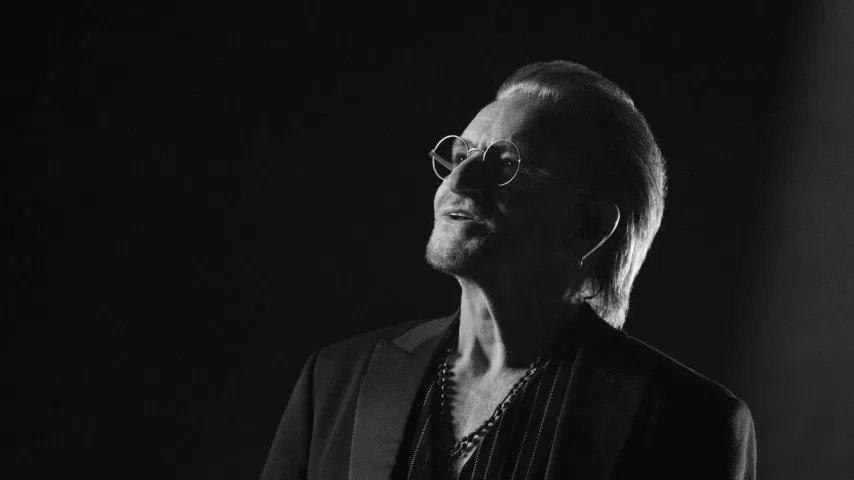
In November 2022, Bono, the iconic lead singer of the globally renowned Irish rock band U2, embarked on a 14-date book tour forSurrender: 40 Songs, One Story, a memoir he crafted during the pandemic. The events revolved around readings (often dramatized) and intimate musical performances, interspersed with spontaneous monologues and reflective anecdotes.Bono: Stories Of Surrender is a distinct, black-and-white film interpretation of the stage show that Bono describes as “me book what I wrote meself.”
While primarily catering to fans familiar with Bono and U2, director Andrew Dominik’s film also serves as an artistic and effectively concise ode to introspection. Through personal narratives, it highlights the importance of recognizing, confronting, and sometimes exorcising the internal struggles that define us.
Bono remains a divisive figure across various online platforms, a phenomenon that is often elusive to define. This division partly stems from the controversial automatic-download of 2014’sSongs Of Innocence, which irked many Millennials who typically accept technological interruptions in their lives. Additionally, some are from the “shut-up-and-sing” brigade, fatigued by his activism, which seems contradictory for any true U2 fan, considering the band’s long-standing commitment to their beliefs.
Surprisingly, many find Bono’s tendency for “too much” to be off-putting. This feeling often links to his inclination to overshare, deconstructing the persona of the rock star. While certain U2 tracks, like “Sunday Bloody Sunday” and “Pride (In The Name Of Love),” have clear narratives, Bono has consistently felt compelled to elucidate the backstories of nearly every song and, within U2’s lyrics, engage in significant self-reflection.
- Lady Gaga adds U2 to her growing collection of classic rock stars after appearance at The Sphere
- Everyone agrees: Humanity peaked with U2’s first performance at the Las Vegas Sphere
For those who yearn for a hint of mystery and flair in rock music, this can render him uncool. Conversely, one could argue that by exposing his tumultuous inner conflicts, Bono displays a deeper authenticity. This unrefined sincerity is at the heart of Stories Of Surrender‘s charm. It aims to connect and heal divides—between loved ones, across communities, and within oneself.
The film opens with Bono poetically recalling a serious health scare (a blister on his aorta during Christmas 2016). U2 fans will find many of the subsequent narratives familiar. He pays tribute to his wife Ali and his bandmates (symbolized by three empty chairs), all of whom he met within a week as a teenager. As the youngest child of a Catholic father and Protestant mother, the pivotal moment of Bono’s youth was the sudden passing of his mother Iris, who collapsed during her father’s funeral when Bono was only 14, leaving him in a grief-stricken household where emotions were rarely discussed.
Humorous anecdotes pepper the film as well. One amusing segment recounts how Luciano Pavarotti (much to the chagrin of Adam Clayton and Larry Mullen Jr.) interrupted a rehearsal to propose a concert featuring “Miss Sarajevo” in Modena, Italy. Bono also brings levity to a crisis of faith experienced by three members of U2 during their early engagement with the devout Christian sect Shalom, highlighting their manager Paul McGuinness’s clever response when they considered disbanding: “Would God think it okay to break a legal contract?”
A significant portion ofStories Of Surrender delves into Bono’s relationship with his emotionally unavailable father Bob, for whom he would later have weekly pub meetings, striving to find something impressive enough to answer his father’s usual question: “Anything strange or startling?” Bono reflects, “I spent most of my life trying to figure out the opera inside my father’s head… so I sang louder. And louder.”
While U2’s music is crafted for stadiums, their grand sound and theatricality can sometimes overshadow their ability to create intimacy in unexpected environments. This talent is showcased inStories Of Surrender, featuring a minimalist stage designed by U2’s long-time set designer Willie Williams, yet incorporating some dramatic elements (like a set of flashing background lights) that nod to its emotional depth.
Bono is joined on stage by musical supervisor Jacknife Lee, alongside Kate Ellis on cello and Gemma Doherty on harp and other instruments. Approximately a dozen U2 tracks—including “Vertigo,” “City Of Blinding Lights,” “Out Of Control” (written on Bono’s 18th birthday), “I Will Follow,” and “With Or Without You”—receive meaningful attention, typically in concise segments that relate to the specific time or emotion of a related monologue.
Stories Of Surrender is framed as a narrative feature, performed for the camera rather than the audience, who remain mostly in the background or out of focus, aside from an eight-minute opening credit sequence and a moment of catharsis during the movie’s brisk 86-minute runtime. This decision to minimize audience shots is one of Dominik’s most effective choices, allowing the subject’s vulnerability to take precedence.
Stage-locked, over-the-shoulder shots are common in concert films and biopics, but Dominik (The Assassination Of Jesse James By The Coward Robert Ford) alongside cinematographer Erik Messerschmidt keeps the camera dynamic, opting for varied angles, moving in and out, and circling the subject. Combined with a black-and-white presentation that accentuates details and encourages viewers to reflect on Bono’s introspective expressions, the final product conveys both playful energy and a tranquil sense of acceptance—of surrendering to larger forces, wherever they may be found.
U2 has consistently embraced cutting-edge technology, from pioneering the ZooTV and U2 360° world tours to producing a3D concert film and their recent residency at the Sphere in Las Vegas.Stories Of Surrender continues this legacy, being released in both 2D and as the first feature-length film available in the Apple Immersive Video format for the Apple Vision Pro headset.
The immersive version required filming the performance twice using different camera setups. While this feature may seem like a bonus rather than an essential element, one can imagine the thrill of virtually sharing the stage, especially amidst the swirling, golden cursive of Bono’s handwriting that occasionally appears, alongside cleverly used “double Bonos,” such as when he addresses the irony of being a wealthy activist.
Ultimately, it’s the content and its underlying themes that carry the most weight inStories Of Surrender. Bono’s wry observation, “You might not want to give up the emptiness that gave you everything,” reflects the profound contemplation and spiritual tumult of a man who has persistently sought to embrace the world, while recognizing the roots and personal costs of that fervor.
Director: Andrew Dominik
Release Date: May 30, 2025 (Apple TV+)