


[ad_1]
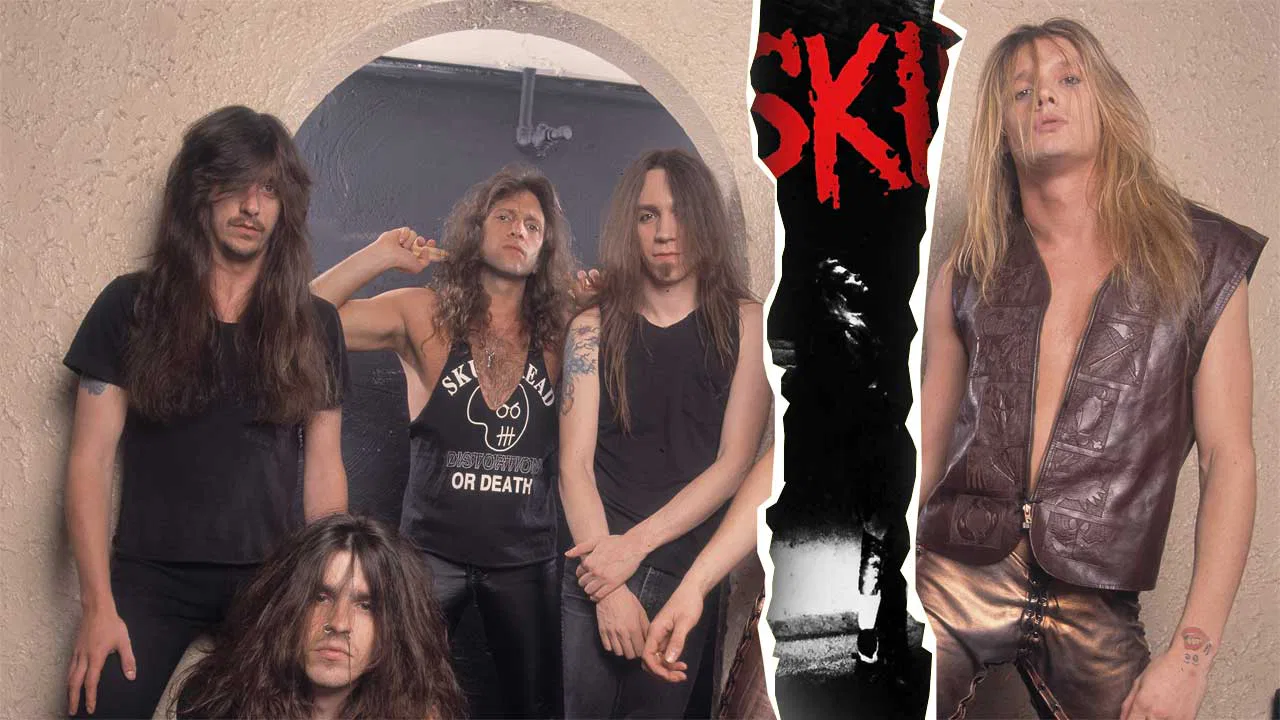
In 1987, guitarist Dave ‘Snake’ Sabo, bassist Rachel Bolan, and drummer Rob Affuso sat nervously in the kitchen of the Sabo family’s home in New Jersey, anticipating an essential arrival. Guitarist Scotti Hill was at the airport to greet this significant newcomer.
Sharing in the palpable tension was Sabo’s mother, lovingly referred to as Mrs. Snake. Their anxious expectation was palpable as they awaited the arrival of the person they believed was going to complete their lineup. After numerous dead-end auditions and bad fits, it was time to make a decisive move.
At last, the door swung open, and the lead singer, whose flight had been funded by Skid Row, ducked inside. Standing at six feet three, with striking cheekbones and an undeniable presence, Sebastian Bach introduced himself with a gleeful shout: “Du-u-u-u-u-u-des! I’ve got a ten-inch dick!”
The stage was set, and for the next nine years, Skid Row would pursue their rock’n’roll dreams—though it wouldn’t come without its challenges. Sebastian Bach was the game-changer that elevated them to global stardom, but his reckless lifestyle was a ceaseless source of friction for the other members. Depending on the day’s dynamics, Skid Row found themselves celebrated, criticized, sued, or raved about for debuting at No.1 on the Billboard album chart; they were seldom overlooked.
Like a comet, Skid Row blazed brightly, yet burned out quickly. When their star dimmed, their fall seemed inevitable. Remarkably, the band resurfaced in 2003 for a UK tour—their first since the 1995 Castle Donington festival—but this time without Bach, leading to a more enjoyable atmosphere.

The Skid Row saga began in 1986 when Dave Sabo met Rachel Bolan (real name James Southworth) at a guitar shop in New Jersey where Sabo worked.

“I’ll never forget that moment,” Sabo reminisces. “This guy walked in wearing a red beret and a pink leather jacket. He looked like a freaking star, so I had to strike up a conversation.
“When it came to songwriting, we quickly realized that despite our different musical backgrounds—me from Judas Priest and Iron Maiden, and Rachel from The Ramones—our styles blended seamlessly. Plus, Kiss and Van Halen were mutual favorites.”
Bolan suggested bringing Scotti Hill (born Scotti Mulvehill) from a previous band, and when their initial drummer got into trouble with the law, Sabo introduced Rob Affuso from one of his past groups. Having performed since his teens, Bolan never doubted he would succeed.

“Being an entertainer is something innate, not something learned,” he insists. “Whether you’re an artist, athlete, or musician, that spark is within you, and you can’t simply shake it off.”
Sabo also felt his path was set early on. He made a pact to become a rock star with schoolmate Jon Bongiovi (who later gained fame as Jon Bon Jovi), vowing to help the other once one made it big.
“It was evident Jon would reach that goal first, but he promised to support us when our band was ready,” Sabo recalls. “He kept his word. Jon attended our shows, offered critiques, and shared invaluable insights.”
Before signing their first record deal, the band rehearsed tirelessly in the Bolan family garage in Toms River, NJ, using kerosene heaters for warmth and blasting the TV to drown out their noise. The influence of Jon and his guitarist Richie Sambora brought them initial expectations, culminating in a signing with manager Doc McGhee.
Bolan notes they hit the New Jersey, New York, and Connecticut scenes hard until they grew tiresome for some audiences. The original singer, Matt Fallon, who had briefly been with Anthrax, lacked the drive of the rest of the group. John Corabi, later of Mötley Crüe, was even offered the role. While Atlantic, Geffen, and A&M showed interest, they were all clear that the lineup needed to be right.

There was a phone call. Various industry insiders had witnessed a young singer jamming with members of Twisted Sister and Zakk Wylde at a wedding reception, which led to Sebastian Bach (born Sebastian Phillip Bierk) getting in touch with Skid Row, quickly leading to an audition.
“He sang in such a high register that we had to work on his vocal control, but everything aligned nicely after some adjustments,” Bolan remembers. “Sebastian was loud and obnoxious, but we needed a strong vocalist. The good news was he had tons of ambition.”
However, it soon became apparent that while he brought immense talent, Bach also came with significant challenges. On the very night of his arrival, an incident occurred at a bar. Bolan remembers receiving warnings about Bach’s volatile nature: “An industry veteran had told me there would be trouble ahead. Yet, the thought of searching for another singer for another seven months was unbearable.”
“We ended up jamming on 18 And Life and other tracks that night,” Sabo recalls. “It went poorly. But Rachel declared from the stage that we’d found our new singer. Later, Sebastian got drunk and attempted to punch a guy, but missed by a wide margin.”
With the band’s chemistry flourishing, they spent a year perfecting their craft. They reluctantly signed a deal with JBJ and Sambora’s publishing company, Underground, which they later regretted due to its impact on royalties. Following a bidding war, they signed with Atlantic Records. It was a close call, however. Their showcase for Geffen, which Sabo described as “miserable,” was met with snobbery from A&R representative Tom Zutaut, who signed acts like Guns N’ Roses.
“One day, Doc told me we had signed with Geffen,” Sabo explains. “It was the moment I’d been waiting for my entire life, but I was disheartened. This was the label that claimed we only had a couple of songs worthy of an album. Tom had asked where we rehearsed, and when I shared, he remarked: ‘Well, you won’t be seeing me in that garage.’ His arrogance astounded me. It felt like Geffen was doing Chef Doc a favor.”
After having rehearsed their songs countless times, recording the self-titled Skid Row album with Dokken and Alice Cooper producer Michael Wagener was a smooth process. From the grand kickoff of Big Guns to the rallying anthem Youth Gone Wild, alongside the softer notes of 18 And Life and I Remember You, their debut was both maturity and quality combined.
Just a year later, after accepting an offer to open for Bon Jovi on their New Jersey album tour, their album sold a million copies in the United States alone. In addition to headlining the most prestigious venues in the U.S. (such as New Jersey’s Giant Stadium with a capacity of 72,000), Skid Row also played their club shows on off-nights.

As singles, both 18 And Life and I Remember You reached the US Top 10. Skid Row soon found themselves rubbing shoulders with heavyweights, even participating in the Moscow Music Peace Festival, an event organized by Doc McGhee as part of restitution for drug trafficking. Other performers for McGhee’s Make A Difference Foundation, aimed at combating substance abuse, included Bon Jovi, Ozzy Osbourne, Mötley Crüe, and The Scorpions. Bolan’s most vivid recollection wasn’t of the concert itself but the pre-event press conference.
“Each band had a member selected, and I found myself sitting next to Nikki [Sixx of the Crüe], Klaus [Meine, Scorpions’ frontman], and Ozzy,” he chuckles. “Klaus was asked what it felt like to be back in Moscow, and he gave a rather clichéd response about rocking it like a hurricane. Ozzy interjected: ‘Oh, what a fucking wanker,’ which nearly made Nikki and I collapse with laughter.”
In August 1989, Skid Row made their UK debut at Milton Keynes Bowl, opening for Bon Jovi, Vixen, and Europe. This was the beginning of a whirlwind romance that led them to headline London’s Hammersmith Odeon just two months later.
“Seeing all those faces in Milton Keynes was indescribable,” Bolan recalls. “I had always dreamed of going to England because my favorite bands—The Beatles, The Sex Pistols, and The Rolling Stones—were from there. Having gained popularity in the States, we felt confident we could replicate that success anywhere. Scotti and I tried to make our way into the crowd to watch Bon Jovi, but we were mobbed.”
During one show at London’s Marquee, Bach famously invited the entire crowd back to the Columbia Hotel for drinks. A sizable group gathered outside, only to be turned away at the door. Furious upon hearing the news, Bach snuck a bottle and some joints out the back, settling in Hyde Park to chat with 50 or 60 fans. This moment illustrated the difference between those truly passionate about rock’n’roll and those driven by ego.
The band’s down-to-earth approach helped them gain immense popularity. They jumped from the Marquee to the Odeon stage, joining legends like Lemmy for Train Kept A-Rollin’ and Steve Harris and Nicko McBrain for Iron Maiden’s Wrathchild. Even Robert Plant was said to be backstage during a party where The Sweet’s Brian Connolly stopped by to express admiration.
Bach honed his frontman skills, learning tricks of the trade from Dee Snider. At Hammersmith, possibly inspired by a bootleg of Twisted Sister given to him, he adopted Snider’s method of confronting pop stars.
While Snider targeted Boy George with his taunts, Bach’s ire fell on pop idols of the time like Jason Donovan, Milli Vanilli, and Bros. After one event, he admitted to me in a headlock: “You must fucking hate me; I ripped off everything from your tape.” His charisma often won audiences over, although not always unconditionally.