



[ad_1]
Sure! Here’s a rewritten version of the content while preserving the HTML tags:

Photo: Courtesy of the subject
In March, I received a call from an unfamiliar number, and to my surprise, a ghost was on the line. If you know anything about musician Bill Fox—“one of my most hesitant heroes,” to quote Wilco’s Jeff Tweedy; “one of the essential artists of our generation,” as declared by CMJ in 1997—you’ll understand he’s a smoky-voiced, harmonica-playing phantom who hasn’t given a genuine interview in four decades. “I don’t seek attention,” Fox shared with the Plain Dealer in 2009, after a daring journalist found him smoking outside his telemarketer office in Cleveland. “I don’t want a story. Respectfully, please don’t write anything.”
In fact, Fox’s aversion to interviews is so profound that the most comprehensive narrative about his life and music surfaced in a massive 2007 piece in The Believer, where writer Joe Hagan fails to connect with Fox. However, through discussions with friends and family, Hagan paints a picture of a tragic figure: withdrawn, inebriated, and allergic to the self-promotion necessary for success in the music industry, a man who squandered every opportunity that came his way. The Believer article marked a rare occurrence in music journalism—writing that actually impacted a subject’s career. Interest in Fox grew, and soon he was back performing small bar gigs in Ohio and releasing new music. Yet, the silence from him persisted.
Requesting an interview from someone like him might seem absurd. Still, I resolved to try after hearing “Terminal Way,” the lead single from Fox’s latest album, Resonance, which captivated me unlike any music had throughout the year. Fox has that effect. His sound—Dylan-esque folk tunes infused with vibrant power-pop energy—commands attention in a way only acoustic tracks can. This contradiction defines Bill Fox: despite his desire for anonymity, his music compels people to delve deeper. No one is content with this dynamic.
Even when informed by Fox’s friend M Ross Perkins, another musician from Ohio, that Fox was open to an interview, I didn’t expect to hear from him. This is a man, after all, described in the Believer as “a temperamental recluse who never returns calls.” Yet, a few days later, he unexpectedly called me.
“Hey, good afternoon,” Fox said, ready to converse.
Being a musician who avoids interviews—or tours, or social media, or accessible music, or printed records, or a manager or publicist—presents both an ingenious and a problematic marketing tactic. This rejection of industry norms compels non-artists in the music space (including journalists) to confront what exactly they contribute—whether their connection to the music is symbiotic or parasitic.
At some point, though, it becomes a distraction. A musician’s mythos like Fox’s risks overshadowing the actual music. However, Fox has managed to avoid this pitfall because, despite his reclusive reputation, his legend is heavily supported by his substantial musical output. Other artists often seem perplexed by his ability to create such profound work with the simplest tools and lyrics.
“It’s a mix of despair and hope,” remarked Matthew Caws of Nada Surf. “Like a cage with a crack of light.” Snail Mail’s Lindsey Jordan recently explored Fox’s catalog when her passion for music was waning due to the burden of her art feeling like a job—a business. The opening track of Fox’s 1998 album, Transit Byzantium, “From a Dark Night,” served as a rejuvenating indie-rock revelation for her. “He describes regaining the ability to smell,” Jordan explained. “It sounds cheesy, but I felt that happening as I listened, like my jadedness was clearing.”
However, devoted fans don’t pay the bills. Over the years, Fox has made a living through what he calls “phone hustling”—telemarketing—and during our call, I realized this method reflects his core essence. “I’ve chatted for hours like this,” he shared. “I didn’t hold the phone to my ear; I was wearing a wireless headset.”
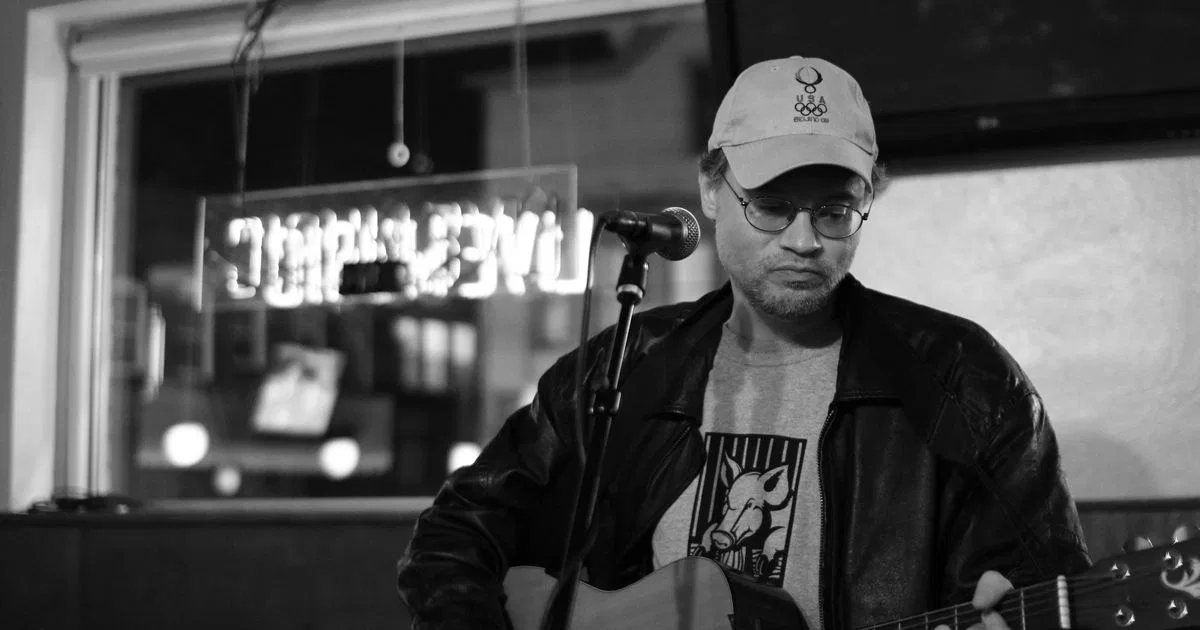
Fox, 59, speaks with a friendly Midwestern accent, his voice as raspy as his singing. He’s courteous, perceptive, and generous with time, ultimately spending over three hours across two calls discussing topics he typically avoids with reporters. He frequently clears his throat and coughs.
Close to his current residence, Fox spent his childhood in a Cleveland suburb with a father who was a quality-control inspector at a dairy and a mother who was a school teacher before stepping back to raise four kids—an American Dream, on paper. Yet, like many families, their reality was more intricate; Fox’s parents divorced before he graduated high school.
In his youth, Fox explored music through his mother’s collection of folk and traditional records: the Kingston Trio, the Clancy Brothers, and “Puff, the Magic Dragon.” He still treasures The Sound of Music soundtrack. “I occasionally stream it,” he confessed. “I love that stuff.”
As a teenager, Fox had an electric guitar without an amplifier and soon began making music with his younger brother, Tommy, who crafted a percussion instrument from an oversized suitcase their father used while traveling for sales. “Tommy would hit it with spoons,” Fox recalled, “while I strummed the electric guitar close to the tape recorder and sang. We had an absolute blast.”
With Ken Hall on bass, they formed the Mice, a trio reminiscent of a heartland version of the Buzzcocks, with Bill’s fierce vocals and Tommy’s intense drumming making a track like “Not Proud of the USA” a genuine protest in Reagan’s era. The song’s chorus—”Dad, I’m not proud of the U.S.A.”—was sure to annoy their right-wing father, who lost an ankle in the Korean War.
The Mice began to gain traction, especially in the Midwest, significantly influencing Robert Pollard of Guided by Voices. Tim Rossiter, Fox’s long-time friend and ex-manager, recounts that before a Guided by Voices performance in the early ’90s, Pollard burst into the room, exclaiming, “Is Bill Fox here?!” Pollard, who would later achieve rock-and-roll fame alongside the Ohio music scene, insisted Fox join him onstage for an impromptu rendition of the Mice song “Little Rage.” “Pollard was hammering him with questions,” Rossiter remembered, “like, ‘How do you write songs? What’s your process? How do you do it?’”
The Mice faced a pivotal moment with a planned U.S. and European tour—but Bill canceled it last minute, leading to the group’s disbandment. Fox explained that he felt disconnected from their music and was eager to pursue new directions. According to the Believer article, Tommy revealed he didn’t speak to Bill for two years following that. (Tommy declined an interview request for this piece.)
Fox has no regrets about “dissolving” the band. This decision ushered in a fruitful era where his songwriting rapidly evolved into the style he is now celebrated for—tracks like “Lonesome Pine” and “My Baby Crying,” which feel so fundamental they seem to mirror an earlier standard that you can’t quite identify. “After the Mice, when he really began to write music, I realized, This guy is one of the great songwriters—an important songwriter. I genuinely wanted the world to recognize that,” Rossiter stated.
Despite Fox’s reputation for sabotaging opportunities, Rossiter and he tirelessly pursued labels’ attention in the ’90s without success. Ultimately, they decided to self-release his debut album, Shelter from the Smoke, in 1997 and see how it fared. The 73-minute collection showcased Fox’s range—from full-band tracks to homemade 4-track recordings. (In the song “Sara Page,” you can faintly hear TV chatter in the background.) CMJ, a key authority on alt-rock at the time, labeled it the “secret record of the year.” For Rossiter, it was proof he wasn’t alone in his belief: “I felt, Oh my God, we wereright.”
In 1998, Fox released Transit Byzantium and captured the attention of Sire Records executive Seymour Stein, renowned for signing iconic bands like the Ramones and Talking Heads. Fox traveled to New York to perform for Stein, and Rossiter recalled he “really blew him away.” “It was clear there was this passionate intensity of, Here’s the record industry; take it all in.” Yet, a deal never came to fruition. Fox was reluctant to keep traveling to New York; he didn’t want to record in Nashville, as Stein suggested. He ceased returning calls, and the momentum dwindled, as Fox recounted.
Upon asking Fox why he withdrew just when opportunities seemed promising, he paused, reflecting. “I think it stems from my desire not to become a successful artist
dependent upon me consistently producing on demand,” he explained. “I feared the consequences; I didn’t want to confine myself in a way I believed would hinder my creative process. For me, that approach simply wouldn’t work.”
During this period, Fox stepped away from music completely, even living without a guitar. He referred to that time as “one of those moments” where music took a back seat to simply striving to exist. “Perhaps I’m a bit dysfunctional,” Fox admitted. “I immensely respect those who maintain solid jobs, work 9 to 5, are good partners, and raise children. To me, those people are true heroes.”
As I drafted my initial email to Joe Hagan, I felt uneasy. The writer—now a special correspondent for Vanity Fair—had made every effort in 2007 to secure an interview with Bill Fox, including traveling to Cleveland, only to leave empty-handed. I worried that contacting him almost two decades later would seem arrogant—like I was saying, “That wasn’t too tough, was it?” But Bill Fox aficionados form a special community, and Hagan graciously replied, “I’m thrilled you reached him. Sounds like he’s become more open over time.”
Interestingly, the piece Hagan filed for The Believer has gained its own following, partly because he didn’t manage to connect with Fox. His absence emphasized the ghostly narrative woven in red ink within Fox’s life and music. “His resistance to engage,” Hagan mentioned, “is deeply embedded in what makes his music special. The isolation reflected in his work is tangible.”
Hagan gathered extensive insights into Fox’s life primarily from Tim Rossiter and Tommy Fox, some of which veered into ethically nebulous territories, particularly for an artist who wished to remain out of the limelight. It included frank discussions of Bill’s battles with manic depression, including his “history of hospitalization.” At one point, the article highlights a public incident Fox experienced in 1993, covered by the Plain Dealer with the headline “Wounded Man Waves Knife, Shouts about the Antichrist.”
Fox’s justification for avoiding press in the 2000s was his work for the police—telemarketing for the National Crime Prevention Council, selling ads for McGruff the Crime Dog brochures. He feared—then and now—that his job could be compromised by his artistic persona. (Respecting Fox’s wishes, The Believer refrained from publishing the online version.)
The legitimacy of his concerns remains uncertain. What kind of business would reprimand an employee for pursuing art in their free time? Yet, the article did portray Fox as a sometimes erratic individual—a person who would abandon his broken-down car on the highway without a second thought. He shared with me his lingering frustration, recounting how he was “let go” a few months after the article’s publication. “I don’t assert this as fact, but I think there’s circumstantial evidence linking it to that Believer story,” he remarked, adding a note of skepticism.
However, at this stage, Fox considers it “water under the bridge,” and Hagan feels content with how he handled the situation. “Withholding information felt dishonest based on what I knew,” he reflected regarding the breakdown. “It connected to the larger narrative.”
Shortly after the Believer article, amid a resurgence of interest in his work, Fox returned to music. When I asked about his motivation, expecting a deep explanation, he candidly stated it was simply because friends informed him he could earn $150 playing a bar gig. “I thought, ‘Absolutely, I’ll take that!’” he recounted. With minimal notice, the venue filled up. (“Perhaps thanks to cell phones and Facebook.”) That kind of performance—where patrons chat and mingle as much as they listen—is where Fox truly feels at home. “To me, that’s heavenly,” he remarked.
This creative resurgence ignited the release of a new album, One Thought Revealed, in 2012, and a broader distribution of a previously cassette-only album, Before I Went to Harvard, in 2017. However, lacking mainstream promotional avenues, interest began to wane again—bothering Fox more than you might anticipate.
“When Before I Went to Harvard debuted in 2017,” Fox lamented, “only one review came out—just a local community paper in a Cleveland suburb. One review.”
Fox’s tendency toward isolation has cultivated a fascinating folktale, but events like this revealed he certainly yearned for people to hear his work. However, by following such a solitary path, he has lost control over his narrative, which is left in the hands of others, potentially turning him into some enigmatic zoo creature. Not everyone in his circle appreciates this portrayal.
“I’m not a fan of that take,” Doug Gillard, long-time guitarist for Guided by Voices, expressed. “The intellectual perspective that they’ll watch Daniel Johnston and ponder, ‘It’s phenomenal. He’s so pure.’” Gillard, who plays on “Wildflower,” a track from Resonance, insisted with frustration that Fox isn’t simply an idiot savant producing incredible music effortlessly. “He’s incredibly skilled and possesses a songwriting talent,” Gillard emphasized. “He also puts in the work.”
I never received a definite answer from Fox about his sudden willingness to communicate. Yet, I suspect it’s a form of concession—a grudging acknowledgment of the industry’s demands to achieve the baseline recognition he deserves. Overall, he remains without significant industry backing. Resonance was released by his friend BillMike, who expressed hesitance about even labeling his Eleventh Hour Recording Company as an official record label, despite having released more than a dozen albums. (“I’ve never actively promoted them,” BillMike shared.) Yet, music needs an audience, and Fox is still searching for a viable way to connect without relying on traditional industry channels. Thus, he donned his headset and agreed to chat with me.
“Can you really fault him for that?” questioned Perkins, assisting Fox with publicity. “I can’t. Choosing to be reclusive, feeling disdain for an industry intent on commodifying your art, resisting an industry focused on appearances—what’s irrational about saying, ‘I’m good without that’? If anything, it’s more irrational to jump into that lifestyle.”
Resonance contains some hidden punk essence beneath its surface. Although presented as a “new” album, all tracks were created before 2010, with some dating back to 1990, specifically “Wildflower.” However, this aligns with Fox’s usual approach: Shelter from the Smoke and Transit Byzantium, he pointed out, also featured older recordings. The timing and manner of their release resonate with him. “It’s relevant to me in the present,” he asserted regarding Resonance. “And I trust it will strike a chord with those who hear it—if they are willing to listen.”
The first conversation I had with Fox left me completely unprepared. Without a scheduled interview, I hadn’t prepared questions, so I had to improvise. I worried he might never communicate with me again—what if this was the last time he ever spoke with a reporter?—so a barrage of questions spilled out. Before our chat ended, I searched for a broader question for a musician who pushed back against the music industry—a man who could’ve been a star if he had chosen to be. My inquiry was: “Do you have any regrets regarding your career?” He seemed to find the question absurd.
“I don’t think of anything as a career,” he replied with amusement. “I focus on the music itself—what I’ve created—and on life itself beyond daily routines. The passions, trials, and tribulations we all encounter. But I don’t see this objectively as a career of any kind. Did I answer your question?”
[ad_2]
Source link