



[ad_1]
Lotti Golden was determined not to let her opportunity slip away. At 17, still completing her senior year at Canarsie High School in Brooklyn, she had secured a songwriting position with Saturday Music, a song publishing company in Manhattan. However, Golden had greater aspirations. So, when her boss, Bob Crewe, unexpectedly entered a crowded elevator with her, she recognized it was time to pitch him the idea of making a record.
“I had never encountered him before. He was hardly ever seen around the office — very elusive,” Golden, now 75, reminisces about that significant afternoon in the spring of 1967. “It was surreal. That instant lingered with me. We often have limited time to make decisions. Should I say hello?”
She introduced herself, and it paid off. Just three weeks later, Golden found herself in Crewe’s office, guitar in hand, ready to present the songs for her debut album, Motor-Cycle. “He was utterly astonished,” she recalls. “After the first song, he exclaimed, ‘My God, who are your friends?’”
Golden’s friends were an eclectic mix of misfits and underground outcasts from the East Village and Lower East Side. Drag queens, drug dealers, aspiring artists, and soon-to-be burnouts, all gravitating towards oblivion — the gritty backdrop to the approaching Summer of Love.
Crewe, known for his work writing and producing hits for the Four Seasons and Frankie Valli, had never encountered anything quite like this. He immediately agreed to record the album.
Motor-Cycle was a bold introduction, a comedic rock melodrama that vividly depicted Golden’s gritty milieu. The songs featured almost no traditional structure, just complex suites that resembled Motown on an acid trip. Atlantic Records offered her a contract, and as the May 1969 release date neared, everything seemed to come together. She was featured in Look magazine, spotlighted by Newsweek, participated in photo shoots for Vogue, and had one of her songs recorded by Patti LaBelle and the Blue Belles.
“I was truly expecting some support. But I was so young — just 19,” Golden reflects. “I thought, ‘The major players in the industry are backing me. I can’t fail.’”
But things didn’t unfold as she anticipated. Atlantic oddly mishandled the release of Motor-Cycle, failing to promote it or release a proper single, and even refused to assemble a band for her live performances. Her dream dissipated almost overnight. She never recorded for Atlantic again, and after producing another album she prefers to forget two years later, she stopped releasing music altogether.
Now, after over half a century out of print, Motor-Cycle has the opportunity to be revived from obscurity through a deluxe reissue by High Moon Records, a boutique label known for reissuing cult classics like Gene Clark and Love’s Arthur Lee. The album has languished for decades as an incredibly rare cult favorite, a bizarre and inspired snapshot of New York City’s counterculture, with seven songs spanning rock, jazz, R&B, and show tunes, almost half exceeding eight minutes and none shorter than five.
Punk legend Richard Hell, who moved to Lower Manhattan in the late Sixties, finds Motor-Cycle to be a revelation. “I was surrounded by the people she describes,” Hell reflects, referring to “the drug heads and cheap street mystics” seeking to escape society. He hadn’t heard the record until High Moon invited him to write liner notes nearly a decade ago. “This record is the first I’ve encountered that genuinely embodies someone living that street life, depicting their surroundings,” he observes. “It’s really captivating.”

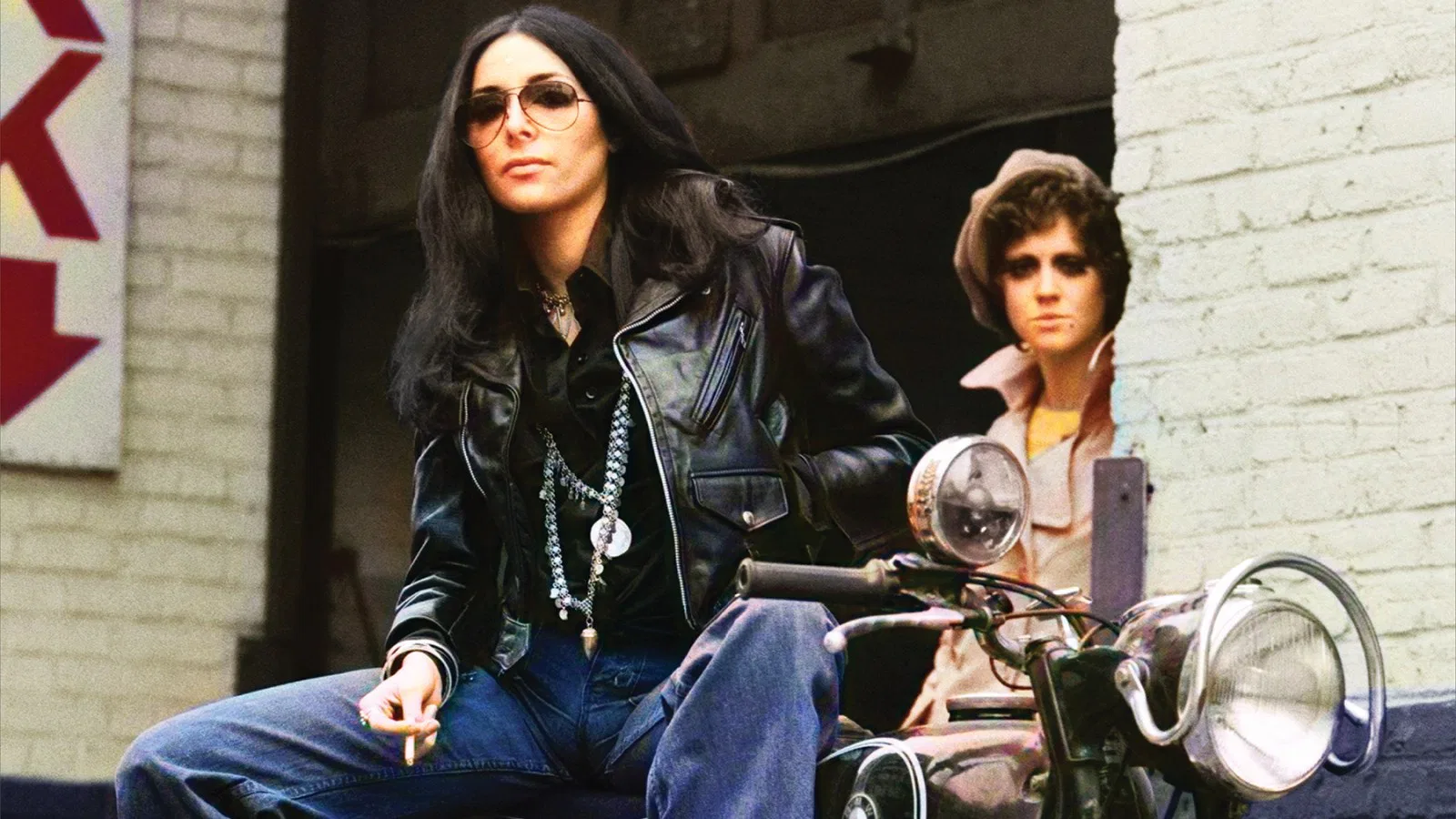
Golden, in her East Village apartment in 1969, portrayed the voices of lost souls and artists on ‘Motor-Cycle.’
Baron Wolman*
However, Lenny Kaye emphasizes that it’s not for everyone. “It’s one of the most peculiar records I’ve encountered,” says Kaye, a founding member of the Patti Smith Group. “The narrative she conveys is so outrageous, and the characters so uniquely flawed, that the risks Bob Crewe took in the arrangements, alongside her distinctive vocal interpretations, create an entirely unique listening experience.”
“It consistently leaves you feeling unmoored,” Kaye adds, “at every turn.”
Today, Golden still resembles the leather-clad girl from her early press photos. In the lobby of an Upper East Side hotel, her jet-black hair complements her outfit, and her oversized sunglasses remain on. Golden grew up surrounded by jazz and experimental theater, her parents operated a lunch counter in Brooklyn. As a young girl, she immersed herself in the playbills they brought home from the Jewel Box Revue, a traveling drag dinner show, and the off-off Broadway Theatre of the Absurd in Greenwich Village.
After receiving a guitar for her 11th birthday, Golden began penning her own songs. She recorded herself on a reel-to-reel tape recorder in her bedroom, attempting to emulate Ronnie Spector or the Shangri-Las. It wasn’t long before she mustered the courage to navigate the subway and present her songs to publishing houses around the city, including the influential Brill Building.
“That’s how it worked back then,” she says, dismissing the fact that she was only 15 at the time. “You had to perform your song live in their office, bring a guitar — the whole nine yards. If they liked it, they’d sign it, and you’d record a demo.” Her bold, soulful voice made her an ideal candidate for demo recordings, which landed her the role at Saturday Music, where she earned $100 a week.
Eager to study theater, she enrolled in acting classes at the Henry Street Settlement during junior high, where she encountered the characters who later populated Motor-Cycle. While exploring playwriting, she shared classes with stars like Mia Farrow. One memorable acquaintance was Michael, an older boy who fancied himself a guru, who introduced her to various neighborhood gatherings.
“It was a wild culture I had no idea existed, but it fascinated me,” says Golden, who also glimpsed the more glamorous scenes at Andy Warhol’s Factory and the Chelsea Hotel. “I viewed it almost like a journalist. But it was easy to get swept up in it.”
As for how deeply she got caught up, Golden just chuckles. “It’s gradual. Like watching your hair and nails grow,” she comments, wiggling her fingers adorned with large silver rings.
The summer after her high school graduation, Golden ventured to North Carolina to study at the Flat Rock Playhouse near Asheville. There, she formed a close friendship with a pregnant single mother named Silky, who had been abandoned by her husband for another man. Like Michael, Silky became a muse and dear friend. They formed the heart of an ensemble cast that Golden initially envisioned for an absurdist play, later adapted into music. “They were thrilled to be immortalized in that way,” she remembers of her friends.
Golden goddess: The singer in New York’s East Village, 1969.
Jim Cummins*
Work on the album commenced in the fall of 1968, and Golden states the recording happened in a concentrated burst over two eight-hour sessions. Crewe insisted she deliver her vocals live in one take, without overdubs. “It was incredibly challenging. You needed to be an athlete,” she remembers, tightening her limbs as she recalls. Golden approached the extended sessions with exuberance, scatting and improvising through the many abrupt stylistic shifts. One moment, she’s the soulful lead on “Motor-Cycle Michael.” The next, she unleashes primal energy on “Gonna Fay’s.”
“She possesses a remarkable talent,” Hell states regarding Golden’s vocals. He compares Motor-Cycle to the Velvet Underground, devoid of the detachment or irony. “Her enthusiasm captivated me,” he remarks. “It’s the sincerity — she gives her all throughout. You can genuinely feel that. It’s quite endearing.”
The songs themselves underwent extravagant embellishments, which Golden didn’t always appreciate. Crewe piled on guitars, pianos, strings, horns, and even a children’s choir with the theatrical flair of a Las Vegas music director. “You’d think 24 tracks would be sufficient,” Golden reflects. “Not for Bob Crewe.” A recently discovered demo of “Dance to the Rhythm of Love,” a song Patti LaBelle released in March 1969, illustrates how Golden envisioned Motor-Cycle — a wiry, energetic soul-rocker where she plays the commanding band leader.
Yet, from a conceptual perspective, Crewe’s strategy resonates: The exuberant overproduction complements the absurdity of Golden’s lyrics. “Many of the stories are satirical, and he translated that satire into music,” she reflects. “In hindsight, I can appreciate that.”
Though not strictly a concept album, Motor-Cycle acts as a loose song cycle chronicling Golden’s drug-fueled journey. It opens with the cosmic odyssey of “Motor-Cycle Michael,” takes a turn in “A Lot Like Lucifer,” unveiling Michael as a predatory con artist, and culminates with the catchy anthem “Who Are Your Friends,” inspired by Crewe’s initial reaction to her songs. The journey concludes with the powerful gospel of “You Can Find Him,” where she claims no man, deity, or substance holds the key to enlightenment.
Motor-Cycle reaches its boldest heights with Golden’s episodic storytelling, as exemplified in “The Space Queens,” narrating Silky’s quest for “a real butch guy,” and “Gonna Fay’s,” a chilling account of a party gone wrong. “The Space Queens” transitions from a spontaneous wedding in Georgia to a drag party in New York, stopping for a baptism in Central Park and humorous exchanges with a hungover dealer named Buzz. “Gonna Fay’s” abruptly eliminates its main character midway, leaving partygoers to callously seek their next high elsewhere.
Golden embodied the role of the rebellious flower child so convincingly that her reputation preceded her. When an unknown Bob Gruen was brought on for a photo shoot for the album, he found her to be nothing like the “wild girl” Crewe had described. “She was genuinely sweet,” Gruen shares. “She was a strong, independent individual with her own visions.” One of his photos, capturing Golden peering through Venetian blinds, graced the back cover. It marked his first professional foray into music photography. “That was a monumental moment for me,” he recalls.
Why Atlantic so poorly mishandled Motor-Cycle‘s launch remains an enigma. It’s likely that larger dynamics within the company worked against Golden: their recent acquisition by Warner Bros. had shifted priorities, with co-founder Ahmet Ertegun — once a personal advocate for Golden — now prioritizing British rock acts like Led Zeppelin. While Golden notes it would have been easy to trim certain songs for singles, Kaye suggests the album might have posed too challenging for radio play.
“She took a risk, and I applaud that — let’s do something as avant-garde as possible within the realm of pop music,” he asserts. “But that’s a gamble.”
It’s possible Golden was simply too unconventional for a major label of her time to handle, especially as a solo female artist writing her own rock songs. Gruen suspects as much.
“I doubt there were many options for her. It was a very misogynistic era,” he comments. “It mostly depended on the whims of an A&R guy, who held his own biases. It would have definitely been challenging for them to figure out how to promote a strong, independent woman who didn’t conform to the stereotype of a sweet folk singer or someone they could relate to.”
Golden takes a more pragmatic viewpoint, attributing her lack of a manager as a significant shortcoming, leaving her without representation when she needed it most. She recalls observing Laura Nyro and her then-manager, the future record mogul David Geffen, closely at a party at Crewe’s apartment. “He was always right by her side,” she notes. “His dedication was evident.” In hindsight, she believes that was what she lacked. (Not that Nyro was destined for fame either: she saw limited commercial success during her lifetime, with broader acknowledgment of her work coming posthumously in the Nineties.)
Disheartened by the album’s struggles, Crewe pressured Atlantic for greater support. His feeble attempt to provide assistance by hiring Barbra Streisand’s manager, Martin Erlichman, yielded little. “To him, I was like, on another planet,” Golden mocks. Things worsened when Crewe urged the young artist to record a mashup of the Isley Brothers’ “It’s Your Thing” and Mitch Ryder’s “Sock It to Me, Baby,” released as the album’s sole single without her consent.
Atlantic Records co-founder Ahmet Ertegun was a strong advocate for Golden.
“That was a colossal mistake,” Golden asserts, recalling when she was instructed to sing over a pre-recorded track that wasn’t in tune. “I’d never allow that as a producer.”
The failure of Motor-Cycle was devastating for Golden, who, still shy of her 20th birthday, found herself in freefall. “It was tremendously soul-crushing,” she confesses. Momentarily, she removes her sunglasses to wipe her eyes. In the following months, she admits her social life plunged into darkness. “I lacked a support system. I poured all my energy into making the record.”
Despite still being under contract with Atlantic, she lost faith in her prospects at the label. She resolved to terminate her deal and start anew. “Although it was more than a one-album contract,” she acknowledges, “I felt so let down, and without assurances for a new album or a promotional commitment, I sought a release.” She allowed her Saturday Music contract to expire, severing creative ties with Crewe. “My focus shifted to my next record.”
In retrospect, pushing to create a follow-up so soon after Motor-Cycle wasn’t beneficial. “I should have fully grieved the loss,” Golden admits. “I was genuinely depressed.” Instead, she internalized her disappointment. “You start to doubt yourself. So, I stripped away all of that. I removed the leather jacket, the cat eyes, the fake eyelashes, and simplified myself. I sought purification.” Feeling only her failures, she decided to alter her musical direction. “I guess I should write ‘normal,’ conventional songs,” she recalls considering.
She hastily entered a new contract with GRT Records from California, releasing the bluesy, singer-songwriter album Lotti Golden in 1971. Everything went awry with that experience: the producer displayed little interest in nurturing her ideas, the songs emerged half-finished, and the label subsequently faced financial turmoil, going out of business a few years later. Today, the album is only available as obscure YouTube uploads.
“I wish I had only made Motor-Cycle and left it as my legacy,” Golden reflects. “It truly is wonderful, and I take great pride in it.”
Not yet ready to abandon music, Golden explored music journalism during the Seventies, contributing to Rolling Stone and Creem, and performed jazz at Clifford’s Lounge on the Upper West Side. Her unlikely resurgence came as a songwriter and producer when she collaborated with Richard Scher to compose the disco hit “I Specialize in Love,” which, recorded by Sharon Brown in 1982, reached No. 2 on Billboard‘s Hot Dance Club chart and the U.K. Top 40. “It was a phenomenon in New York,” Golden reminisces. “They even sold records from cars on the streets.” They later formed the electro hip-hop ensemble Warp 9, achieving further dance successes with tracks like “Nunk” and “Light Years Away.” Those achievements earned her a songwriting deal with Island Records.
“It was a joyful experience for me,” she states. Still, the memories of Motor-Cycle meant she never attempted to record music herself again. “I wish I had followed my artistic path, but it became too painful for me, understandably,” she admits. “When my success as a writer-producer took off, I simply embraced that.”
To her astonishment, Motor-Cycle began to resurface online in the mid-2000s. She initiated conversations with Light in the Attic Records about a reissue, only to receive a call from High Moon Records confirming they had secured the rights from Warner Bros. That was over a decade ago. Despite the lengthy wait for completion, Golden feels the timing is now right: Revisiting her old songs has inspired her to learn GarageBand in hopes of recording new demos, a goal she couldn’t pursue after losing her home studio due to a divorce 25 years ago. Now, she’s reimagining the album for live performances.
“I wasn’t sure if I could connect with this material or if it still resonated with me,” Golden admits. “But I’ve discovered a way to relate it to my current self.” Excitedly, she takes out her phone and shares a video of herself performing “The Space Queens” with a new band at a local venue. “It’s a joy to do this. Creatively, it’s an exhilarating experience.”
For newer fans like Kaye, simply experiencing Motor-Cycle in all its splendor is fulfilling — even if the album’s revival comes with a hint of what could have been. “I’d choose this Lotti Golden album, as eccentric as it may be, over something more conventional and less captivating,” Kaye asserts. “When I listened to this record, it filled me with joy that it could exist. And even if it took over half a century to finally hear it, I’m thankful it’s available.”
“I’m thrilled for it to be shared and for people to listen to it, as they absolutely should,” Golden expresses. “Even if the music doesn’t resonate fully with you, I think it’s worth appreciating for its authenticity. It’s a time capsule of that era, which I believe is significant.”
[ad_2]
Source link